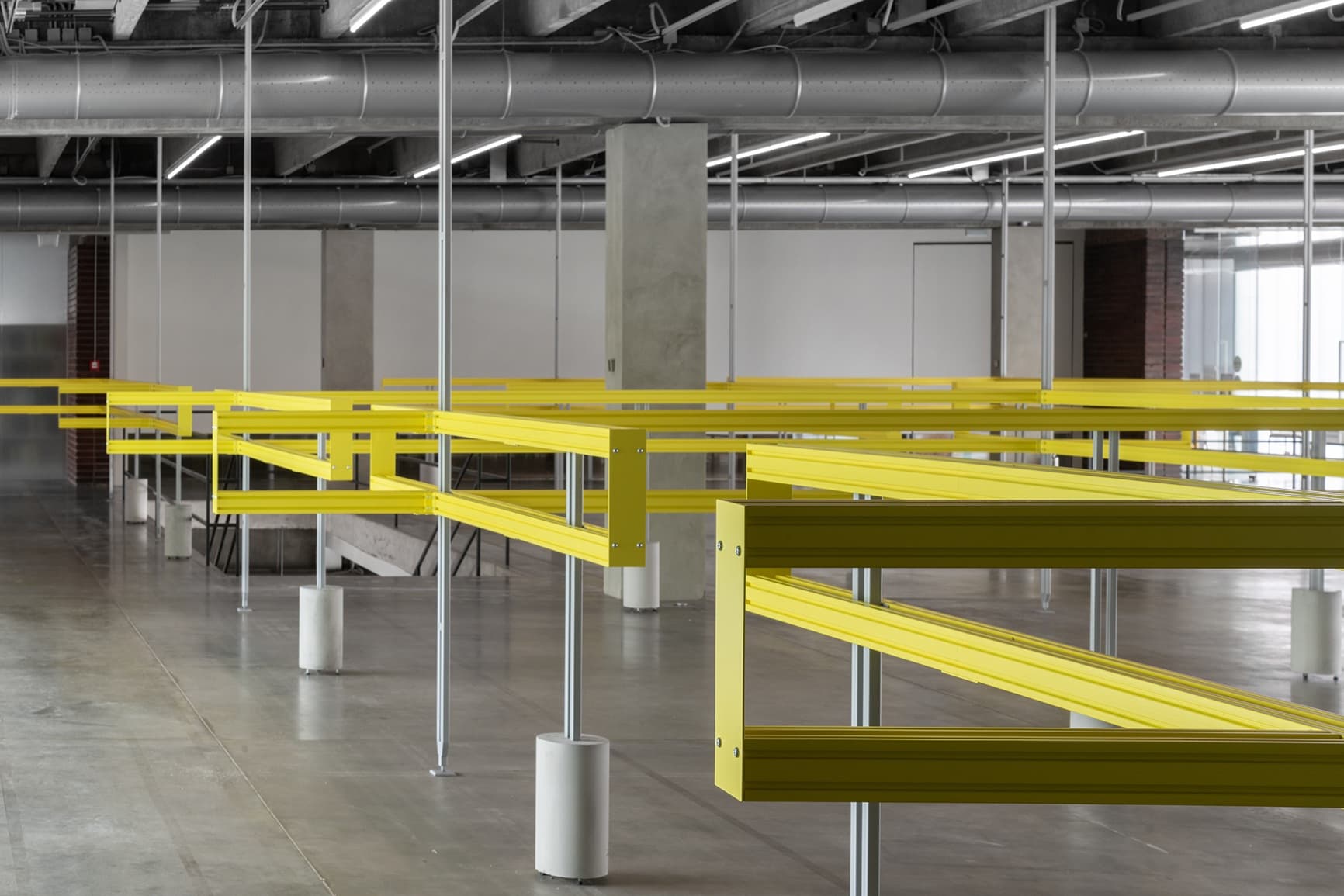
Library of N.F. Fedorov. From the project Russian Cosmism
Igor Makarevich and Elena Elagina

- Category
- MediumMDF, wood, acrylic paint, screws, plastic, wires
- DimensionsDimensions variable
- Сollection
- Inventory numberМСИГ_ОФ_134_И_55
- Acquired from
- Year of acquisition2026
Keywords
About the work
Members of the Moscow Conceptualist movement, Igor Makarevich and Elena Elagina worked with installation, painting, works on paper, and photography. Their works weave the artists’ own mythology, wittily reinterpreting quasi‑mystical, ideological, and cultural codes, while also merging collective memory with personal experience. With an ironic yet thanatic view of life, they explored the cult of cold in totalitarian regimes, fused Soviet utopias with shamanism and psychedelia, and constructed their own cabinets of curiosities.
The installation Library of N F. Fedorov was first presented at the exhibition Philosophy of the Common Task at Perm State Art Gallery (curated by Valentin Diaconov, 2012). The project addressed the legacy of the philosopher‑cosmist Nikolai Fedorov and was installed in a mezzanine space of the Cathedral of the Transfiguration of the Savior, where the museum was located from 1932 to 2023. Makarevich and Elagina assembled an improvised Fedorov library with hard‑to‑find art history publications, placing along the balustrade white coffins that simultaneously served as library tables. They also put desk lamps with green shades on the coffins, with neon quotations from Fedorov’s writings glowing on the walls. The installation united the ideas of Russian cosmism with the museological gaze and the memory of the Soviet avant‑garde. For Makarevich and Elagina, the museum is not so much a collection of “dead things” as a space of reanimation, where lost artifacts and forgotten texts regain a voice. In the artists’ interpretation, Fedorov’s utopia becomes not an abstract philosophy but an artistic memory machine, in which the library, the coffin, and the temple form a single field of meaning, transforming the museum into a site for the possible “resurrection of all generations.”