0,10
Pavel Aksenov, Konstantin Reunov, Avdei Ter-Oganyan
Pavel Aksenov, Konstantin Reunov, Avdei Ter-Oganyan
Date
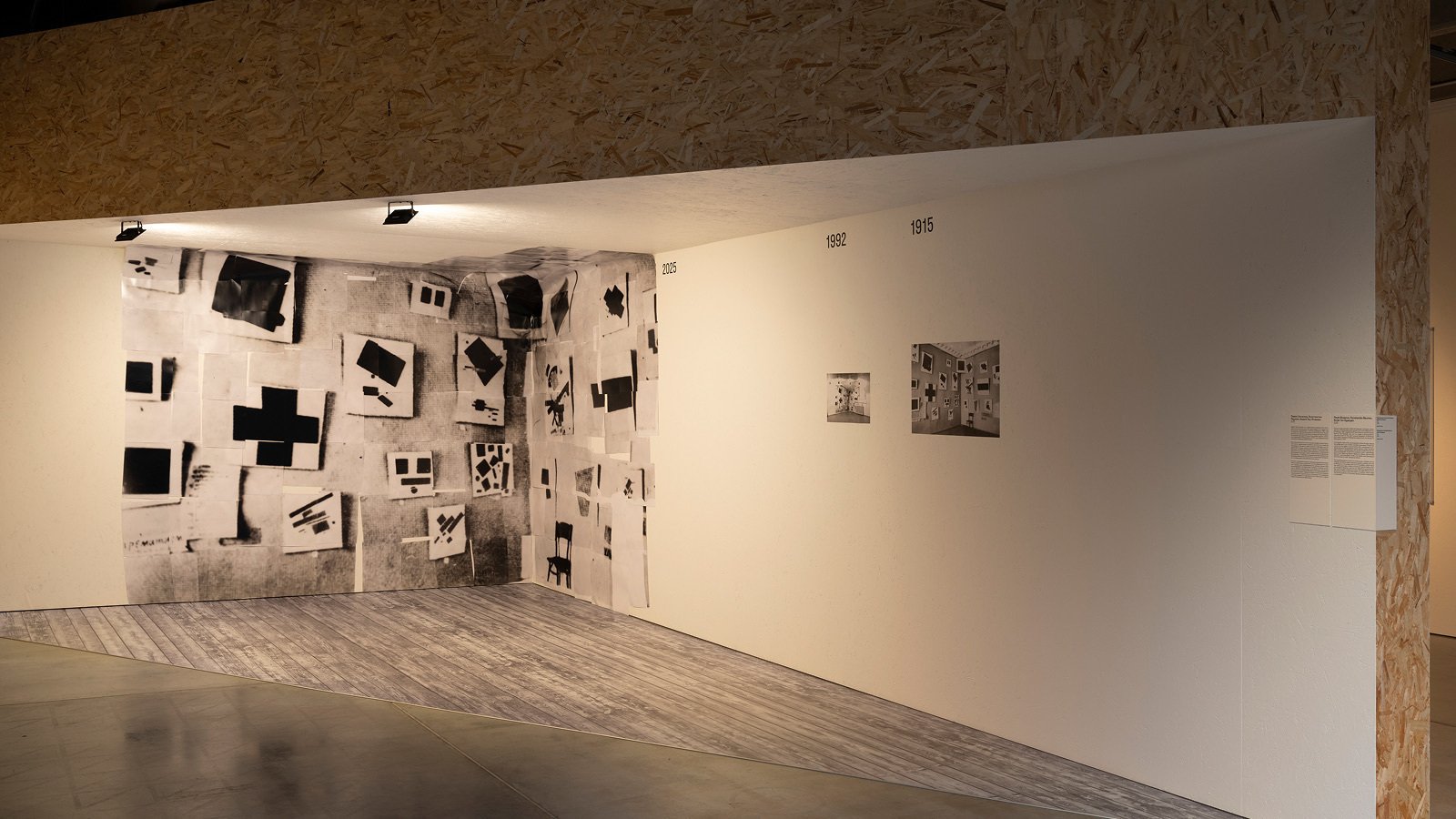
Since he was a student, Avdei Ter-Oganyan had been a keen admirer of the Russian avant-garde in its most radical forms.
In February 1992, together with Pavel Aksenov and Konstantin Reunov, Ter-Oganyan set out to create a photographic reconstruction of The Last Futurist Exhibition of Paintings 0.10, which opened at Nadezhda Dobychina’s Art Bureau in Petrograd in 1915.
To bring this idea to life, photographer Alexei Shulgin helped the artists carry out a rather complex procedure. Firstly, one corner of the gallery was covered with unexposed, numbered sheets of photographic paper placed under red lamp light. Using an epidiascope, the artists projected the famous photograph of the 0.10 exhibition view—specifically the corner featuring Kazimir Malevich’s Black Suprematist Square—onto the paper. Finally, the sheets were developed and returned to their marked positions.
The resulting piece turned out to be a poor imitation of the original: the prints were unevenly spaced, peeling off, and looked blurry. The project did not fit the gallery, which had a low ceiling and was a rather incoherent space. Rather than a homage to Malevich and his non-objective compositions, the work became a statement about the total failure of contemporary artists in the postmodern condition, which made the heroic gesture of the avant-garde pioneers impossible to replicate.
ABOUT THE GALLERY ON TRYOKHPRUDNY
The gallery on Tryokhprudny Lane became a meeting point for the artistic community, which, after many years of stagnating cultural processes and ideological prohibitions, was in need of vibrant and memorable events.
Tryokhprudny brought together people representing a wide range of artistic movements and trends. Seasoned members of the younger generation of conceptualists, who had already achieved international success and whose history was connected to the APTART Gallery, came here. Arrogant, radically-minded Moscow actionists also appeared, as did equally self-assured young art historians—Moscow State University students who were taking their first steps into a somewhat closed professional circle. Elegant partygoers and fans of the neo-avant-garde, whose names history has not preserved, would also drop by. Independent poets, rock musicians, theater people, and even officials from the Ministry of Culture were all keen to attend Tryokhprudny Thursdays. In the meantime, the artists who inhabited the studios—rather exotic figures, representing regional art schools on the Moscow art scene—found their place in the capital’s art world through strategies of interaction and drew more and more personalities into their orbit.
The gallery on Tryokhprudny was a place where an entirely new environment took shape, where important liaisons were born and the most pressing issues in the development of contemporary art were discussed. Friendly conversations and polemical discussions attracted a wide audience that shaped the art scene of 1990s Moscow.
Timeline of exhibitions at Tryokhprudny Lane Gallery (1991–1993) for the display of reconstructions in open storage at Garage Museum of Contemporary Art, 2025–2026