
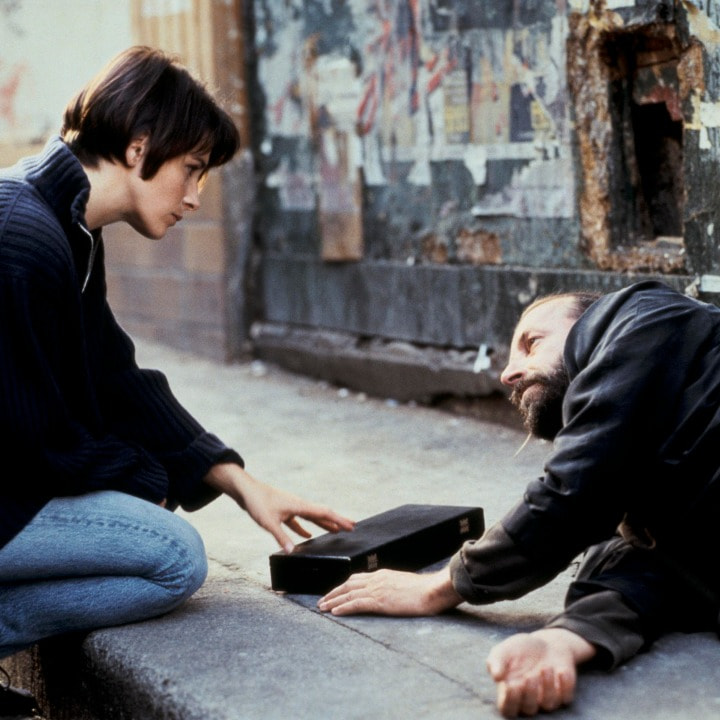
The search for emotional freedom in the first part of Krzysztof Kieślowski’s monumental trilogy.
Julie, a young woman, loses her husband, composer Patrice, and their five-year-old daughter Anna in a car accident. After a failed suicide attempt, she puts her country house up for sale and moves to Paris, where no one knows her. Even though Julie cuts her old ties, the past catches up with her via music, a play celebrating the reunification of Europe after the Cold War, which Patrice had been working on before his death, and to the creation of which she had a mysterious and probably most intimate connection. The opening part of the monumental trilogy Three Colors, exploring the theme of freedom, earned director Krzysztof Kieślowski the Golden Lion of the Venice International Film Festival and the lead actress Juliette Binoche the Cesar Award.
Having finished the large-scale ten-episode Dekalog (1988), in the early 1990s, Kieślowski moved away from the realism of his early socio-political Poland-based pictures, such as Camera Buff (1979), toward a more abstract and poetic cinema made outside his home country. Heralded by The Double Life of Véronique (1991), this magical-realist period culminated in Three Colors (1993–1994), a triptych inspired by the political ideals of the French Revolution: freedom, equality, fraternity. Allowing Kieslowski to implement this ambitious plan into life was both Véronique’s box office success and collaboration with the renowned producer Marin Karmitz, co-author of another filmmaker who came to fame in the 1990s, Abbas Kiarostami.
A famous humanist, whose A Short Film about Killing (1988) played an important role in the abolition of the death penalty in Poland, Kieślowski saw a person not as an island standing on its own. His heroine Julie, connected with her dead husband by the sublime oratorio (composed by the remarkable Polish classic, Zbigniew Preisner), like by an invisible thread, has to realize the mysterious interweaving between people—as does the viewer, who gradually uncovers connections between the three parts of the cycle. Paris through the eyes of Julie appears painfully fragile, shrouded in a mournful haze, as after taking a dangerous dose of sleeping pills (an accomplishment of cinematographer Slawomir Idziak, Kieślowski's colleague since The Scar, 1976). The director’s key achievement, however, is making blue, which dominates the visual solution, not only the usual color of sadness—but also a symbol of freedom, that is possible to obtain, even if at the cost of great effort.
The film will be screened in French with Russian subtitles.
Three Colors: Blue
Dir. Krzysztof Kieślowski
France, Switzerland, Poland, 1992. 98 min. 18+